Google Analytics 360 Just Solved the Marketer’s Biggest Headache: Unified Measurement
Relying purely on last-click attribution is a losing game. With the integration of Meridian (Open-Source MMM) and Future Long-Term Conversions into GA360, Google is shifting the paradigm from tracking clicks to predicting business value.
Let’s be honest about the state of digital measurement today: it is chaotic. Privacy regulations, cookie deprecation, and increasingly fragmented consumer journeys have made traditional attribution models practically obsolete. If you are still trying to prove your campaign ROI by looking at a rigid, last-click dashboard, you are flying blind.
Google knows this. That is exactly why they are overhauling the enterprise measurement landscape with massive updates to Google Analytics 360. By bringing top-down modeling and bottom-up attribution under one roof, they are bridging the gap between what you can track today and what you can predict for tomorrow.
The two game-changers you need to understand immediately are the integration of Meridian (Google’s open-source Marketing Mix Modeling tool) and the rollout of Future Long-Term Conversions. Together, these features transform GA360 from a historical reporting tool into an active, predictive decision engine.
⚡
TL;DR: Data silos are dead. GA360 is blending granular, user-level analytics with macroeconomic MMM data. This allows enterprise marketers to finally measure the true incremental value of every channel—even offline ones—in a privacy-safe, future-proof way.
Key Takeaways
1Meridian, Google’s open-source Marketing Mix Modeling (MMM) framework, is now natively integrated into GA360.
2This unites top-down macroscopic analysis (MMM) with bottom-up granular analysis (Multi-Touch Attribution) for the first time.
3Future Long-Term Conversions use predictive AI to assign long-term business value to mid-funnel actions today.
4This update is specifically engineered to combat signal loss from privacy updates and third-party cookie deprecation.
5Marketers must shift their focus from raw user tracking to feeding Google’s algorithms with high-quality, structured first-party data.
Democratizing MMM: Why Meridian in GA360 is a Big Deal
Historically, Marketing Mix Modeling (MMM) was a massive headache. You had to hire expensive data scientists, wait six months for a report, and manually adjust your budgets based on stale data. It evaluated the broad impact of TV, Radio, and Digital spend, but it was completely disconnected from your real-time analytics platforms.
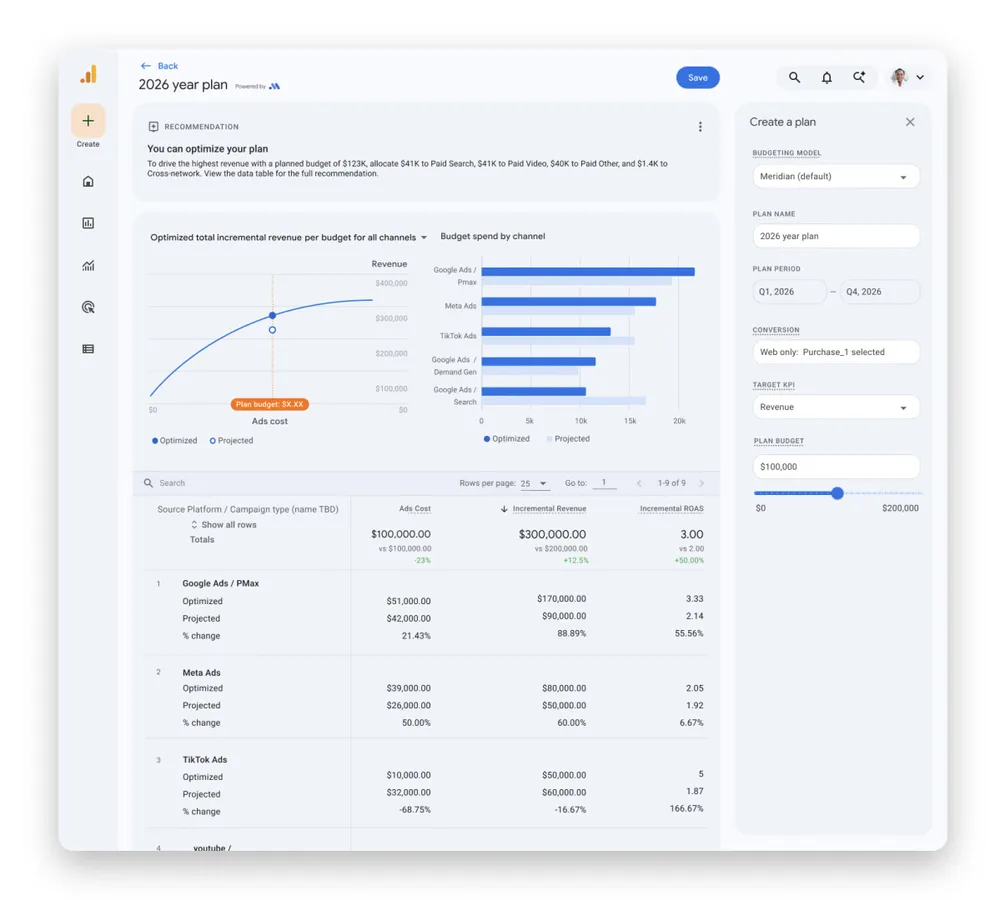
By integrating Meridian directly into GA360, Google is solving the speed and access problem. Meridian is Google’s open-source MMM framework that uses advanced Bayesian statistics to measure incrementality.
Now, enterprise marketers can run sophisticated macro-level models right where their micro-level attribution data lives. You can see how an increase in offline television spend impacts your direct online sales, calibrated continuously with your GA4 conversion data. It is the ultimate holistic view of your marketing ecosystem.
Meridian brings macro-level modeling directly into your daily analytics workspace.Meridian brings macro-level modeling directly into your daily analytics workspace.
The Old Way
✗ MMM reports took months to generate
✗ Data resided in separate static silos
✗ Offline and online impact completely separated
✗ Required massive external data science teams
VS
The GA360 Era
✓ Real-time model calibration and updates
✓ Native integration into your Analytics workspace
✓ Seamless blending of offline media and digital ROI
✓ Actionable outputs sent directly to Google Ads
Decoding Future Long-Term Conversions
If you sell B2B enterprise software or high-ticket luxury goods, you know that almost nobody clicks an ad and buys on day one. Your sales cycle might take 6 to 12 months. Standard ad platforms penalize these campaigns because they look at a 30-day conversion window and conclude the campaign was a failure.
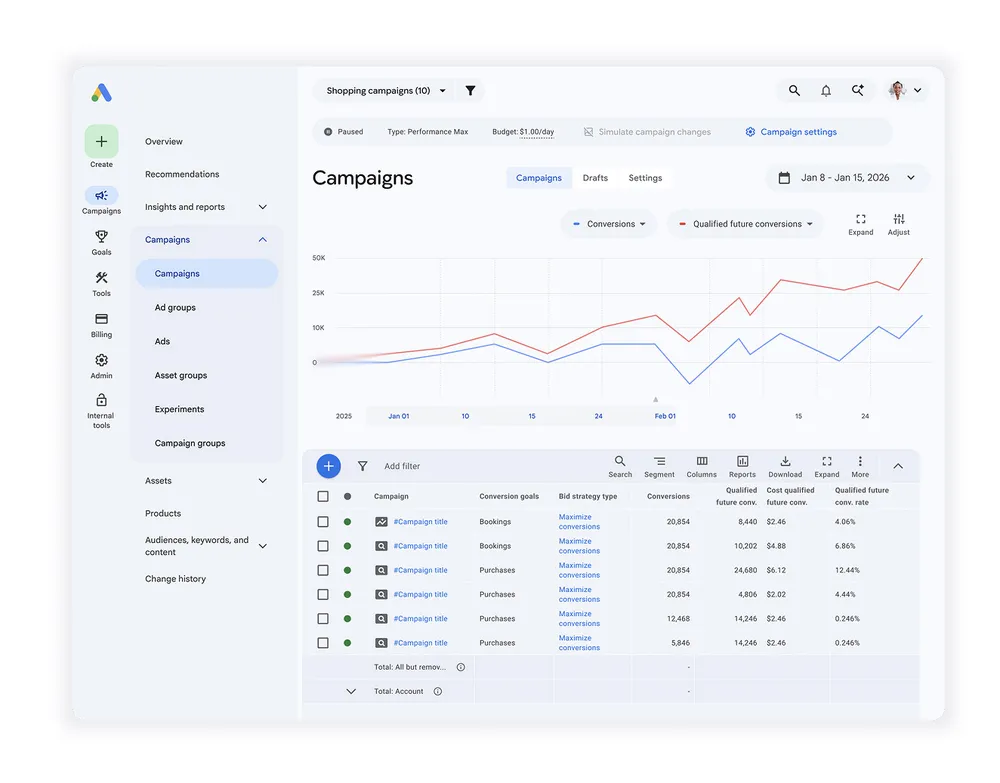
The introduction of Future Long-Term Conversions changes everything. Instead of waiting for a sale to finally happen six months from now, Google’s advanced machine learning analyzes early funnel behaviors—like downloading a whitepaper, watching a video, or exploring a pricing page.
The AI then assigns a predicted future business value to that user right now. This means you can train your Smart Bidding campaigns (like Performance Max) to aggressively acquire high-quality users today, based on the statistical probability that they will convert heavily months down the line.
🔮
Predictive Power
Stop optimizing for cheap, low-intent leads just to satisfy a 30-day dashboard. Start bidding on users with high predicted Lifetime Value (LTV).
🛡️
Privacy Compliant
Because this relies heavily on modeled data and aggregated signals, it works perfectly even when users reject third-party tracking cookies.
📈
Smarter Algorithms
By feeding these predicted long-term values back into Google Ads, you give the algorithm the liquidity it needs to scale complex campaigns.
Your GA360 Adaptation Action Plan ✅
You cannot sit back and wait for these tools to magically fix your ROI. The brands with the cleanest data architectures will win the AI modeling race. Here is what you need to do today.
📋 The Enterprise Measurement Checklist
✓
Audit Your Core GA4 SetupMeridian relies on the accuracy of your foundational data. Ensure your event tracking is spotless and custom dimensions are accurately capturing meaningful user actions.
✓
Consolidate Offline Data StreamsTo truly utilize MMM, gather your historic spend data for TV, Radio, Print, and Out-of-Home. You must integrate these datasets to measure true cross-channel incrementality.
✓
Transition to Value-Based Bidding (VBB)Future Long-Term Conversions only work if Google Ads knows what to optimize toward. Move away from generic Target CPA and implement Target ROAS based on predicted value.
✓
Embrace Modeled Data MentalityStop trying to match your backend CRM to Google Ads click-for-click. Accept that deterministic tracking is dying and statistical modeling is the new gold standard.
FAQs — Understanding GA360’s Evolution
What exactly is Meridian in Google Analytics? +
Meridian is an open-source Marketing Mix Modeling (MMM) framework developed by Google. By integrating it into GA360, Google allows marketers to evaluate the incremental impact of macro-level channels (like Television and Radio) alongside granular digital performance in one dashboard.
How do Future Long-Term Conversions work? +
They use Google’s advanced machine learning to analyze the early behavior of a user on your site. Instead of waiting months for the final sale to occur, the AI predicts the long-term lifetime value of that user immediately, allowing your ad campaigns to optimize for highly valuable prospects in real time.
Do I need to upgrade to Google Analytics 360 to get these features? +
Currently, advanced predictive modeling features and massive dataset integrations like native Meridian reporting are heavily prioritized for enterprise users on GA360, as these features require substantial computing power and massive data volumes to be statistically accurate.
How does this affect Performance Max (PMax)? +
It supercharges it. PMax requires clean, high-value signals to find the right customers. By feeding Future Long-Term Conversion data directly into Google Ads, you give the PMax algorithm exactly the intelligence it needs to scale your business aggressively.
Is MMM replacing Multi-Touch Attribution (MTA)? +
No, it acts as a complement. MTA is excellent for granular, bottom-up digital journey tracking (like comparing a search click to a display click). MMM is top-down, evaluating the incrementality of broad market forces and offline spend. Integrating both gives you the complete picture.
Stop Tracking the Past. Start Predicting the Future. 🚀
The rollout of Meridian and Future Long-Term Conversions within Google Analytics 360 is the clearest signal yet: the era of basic cookie-based tracking is officially over. The future belongs to predictive modeling and holistic incrementality.
Brands that stubbornly insist on matching 1:1 user clicks to immediate sales will find themselves outbid by competitors who are optimizing for long-term predictive value.
It is time to organize your offline data, upgrade your attribution models, and embrace the power of machine learning. Turn your data into your greatest competitive advantage today.